In our previous article, Managed Cloud Services for Customer Experience: A Practical Guide, we explored a challenge many enterprise leaders are starting to recognize: modern CX ecosystems do not stop changing once a migration is complete.
Cloud platforms release new capabilities constantly, while business priorities shift. Customer expectations also continue to evolve. In the meantime, AI introduces new opportunities as well as risks. Yet many CX operating models are still built around a project mindset, where success is measured by reaching go-live.
The result is a disconnect.
Organizations invest heavily in transformation, only to discover that maintaining, evolving, and optimizing the environment requires just as much attention as deploying it in the first place.
That is why managed cloud services for customer experience are becoming an increasingly important category. They address the work that happens after implementation, when CX ecosystems become living operational environments rather than transformation projects.
But how does that actually work in practice?
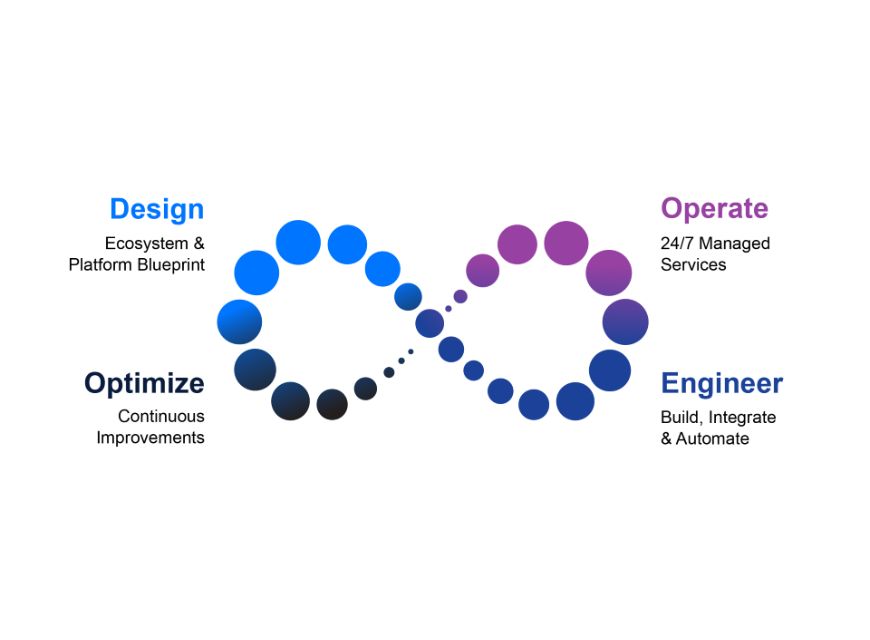
At the center of the MiraCloud approach is a four-stage methodology called DEOO: Design, Engineer, Operate, Optimize.
This article explores each stage, how they work together, and why enterprises are moving away from project-based CX delivery models toward continuous ownership and optimization of CX ecosystems.
Why Contact Center Managed Services Must Extend Beyond Support
The pace of change is accelerating. Gartner predicts that by 2028, at least 70% of customers will use a conversational AI interface to begin their customer service journey. As organizations introduce new channels, AI capabilities, and customer interactions, operating models must evolve continuously rather than relying on the assumptions made during implementation.
Traditional project delivery is designed to produce a defined result against a defined scope. That structure works for a migration or platform implementation, but it becomes restrictive when the operating environment keeps changing.
An enterprise may need to adjust a routing strategy, connect a new data source, respond to a regulatory requirement, improve an AI interaction, or introduce functionality released by a cloud vendor. These requirements do not arrive neatly at the start of an annual planning cycle. They emerge during operation.
A conventional support agreement may keep the platform available, but availability alone does not ensure that the ecosystem remains useful, efficient, or aligned to business priorities.
The challenge is no longer getting a CX platform live. It’s ensuring the ecosystem continues to evolve after go-live.
Continuous CX ownership requires four connected disciplines. Each plays a different role, but they work as part of a single lifecycle that keeps the CX ecosystem aligned to changing business needs.
1. Design the CX Ecosystem Around Business Outcomes
Design begins with the outcome the organization needs to create, rather than with the features available on a particular platform.
This stage establishes the future-state experience and the architecture required to support it: customer journeys, agent workflows, data, integrations, security, governance, compliance, AI use cases, and migration requirements. The output is a blueprint that connects experience goals to engineering decisions.
Resilience should be designed into the customer experience ecosystem from the beginning not added later. Most providers treat business continuity as an operations concern that surfaces after go-live. MiraCloud makes it a Design phase that runs in parallel with architecture, because the decisions that determine whether a contact center survives a bad day are architectural decisions, and they are cheap to make early and expensive to retrofit.
During Design, potential failure scenarios are considered upfront. Recovery objectives, continuity requirements, and customer experience impacts are defined before implementation begins, helping organizations avoid costly redesigns later.
For regulated buyers in financial services, healthcare, and insurance, this is often the deciding criteria. The question is rarely “is the platform highly available.” It is “what happens to my customers when a system I do not own goes down, and can you show me you have tested it.”
For buyers evaluating contact center managed services, the real test is whether the provider can connect business objectives to technical decisions and explain how those decisions will support long-term CX outcomes. A capability inventory alone is not a design method.
A weak Design stage transfers unresolved decisions into implementation, where they reappear as delays, workarounds, integration failures, and expensive post-launch change.
2. Engineer a Connected Contact Center Environment
Engineering turns the blueprint into a working environment.
This includes platform configuration, integrations, workflow development, migrations, testing, automation, and the deployment of approved AI capabilities. The goal is not merely to make individual components function. It is to make the ecosystem operate coherently.
That distinction matters in complex enterprise environments.
A cloud contact center may need to exchange information with CRM, workforce management, identity, payment, reporting, and industry-specific systems. A successful platform deployment can still produce a fragmented customer or agent experience if those connections are treated as secondary workstreams.
Engineering should therefore be assessed at ecosystem level. Buyers should ask how the provider manages dependencies, validates integrations, tests end-to-end journeys, and maintains platform flexibility.
MiraCloud is positioned as vendor-agnostic, supported by more than 1,300 vendor and cloud certifications and over 35 years of engineering heritage. This is intended to support cross-platform environments without tying the customer’s operating model to a single technology vendor.
3. Operate the Environment with Clear Accountability
Once customer interactions begin flowing through the new environment, responsibility can become ambiguous.
The implementation team has completed its scope. Internal operations own platform availability. Business teams own the journeys. Other teams own data, security, integrations, and AI. When an issue crosses those boundaries, resolution slows down because no single party owns the complete outcome.
The Operate stage establishes continuing accountability across the ecosystem, covering operational monitoring, incident management, change governance, integration health, and AI governance in production.
This is where buyers should distinguish between reactive support and active operation. Reactive support responds once an issue has been reported. Active operation identifies platform, integration, and customer journey issues before they materially affect customers or employees. It also creates the operational evidence that determines what gets improved next. Many organizations are also reassessing how AI fits within broader customer experience transformation and governance strategies.
Business continuity does not stop at the design blueprint. In production, it becomes regular testing, failover readiness validation, and operational rehearsals. A continuity plan that has never been executed is a document, not a capability.
AI is one of the reasons the operating model around customer experience is changing. Far fewer can describe what it means once AI is running in production and influencing real customer interactions.
In practice, governance covers how new AI capabilities are approved, what data they can access, how their performance is monitored, and how changes are introduced without creating unnecessary operational or compliance risk. As models, customer behavior, and business requirements evolve, those controls help organizations maintain confidence while continuing to expand automation.
That is the difference between deploying AI and operating it. A model that performs well during evaluation can degrade quietly in production as customer language, product catalogs, and business rules change. Governance is what catches that.
For enterprise buyers, the test is simple. A provider should be able to explain who owns operational outcomes, how changes are governed, how AI is monitored over time, and how operational insights are translated into continuous improvement. If those answers are unclear, accountability usually is too.
4. Optimize Instead of Preserving the Original Implementation
A stable contact center can still become less effective over time.
Customer behavior changes. New functionality becomes available. Existing routing rules accumulate complexity. Automation reaches its initial limit. Reporting may reveal avoidable transfers, repeated contacts, or unnecessary manual work.
Optimization turns operational evidence into structured improvement.
The Optimize stage can include refining customer journeys, routing, integrations, automation, reporting, and approved AI models. The objective is to improve outcomes rather than simply preserve the configuration created at launch.
This closes the DEOO cycle. Operational insights inform optimization. Optimization may require new engineering. Material changes can lead to new design decisions.
The result is a continuous operating model:
Design → Engineer → Operate → Optimize → Design
It’s important to mention that Miratech engagements using this model have delivered 15–40% TCO reduction and a 10–30% automation lift from production-ready AI.
How to Evaluate a Contact Center Managed Services Provider
Before selecting a provider, enterprise buyers should establish whether the offer covers the whole CX lifecycle or only selected technical activities.
Useful evaluation questions include:
- Who remains accountable for the ecosystem after implementation?
- Does the provider connect design decisions to measurable business priorities?
- Can the provider engineer across the required cloud, vendor, data, and enterprise systems?
- How are incidents, releases, security, testing, and continuity governed?
- What process converts operational data into an improvement backlog?
- Can priorities change without initiating a lengthy contract amendment?
- How does the provider protect the customer’s ability to change platforms or technologies?
- Which claimed outcomes are supported by named, cleared, or anonymized client evidence?
A credible provider should answer these questions with a clear operating model, not a capability inventory.
Go-live Should Create a Capability, Not Another Fixed System
The value of a contact center investment is determined over the years it operates, not only on the day it launches.
Design establishes direction. Engineering turns that direction into a connected environment. Operations protect its performance. Optimization keeps it relevant.
Together, those disciplines give enterprises a practical way to manage CX as a continuing business capability.
That’s what Design, Engineer, Operate, Optimize means within MiraCloud. It is also the standard buyers should expect from any contact center managed-services model intended to deliver value after go-live. Talk to a MiraCloud specialist about where your contact center stands, and how Design, Engineer, Operate, Optimize could keep it improving.
FAQ
What are contact center managed services?
Contact center managed services provide ongoing specialist support for the technology and operations behind a contact center. More developed models also cover design, engineering, operational governance, and continuous optimization.
How is DEOO different from implementation?
Implementation primarily creates and launches the environment. DEOO continues after launch by connecting Design, Engineer, Operate, and Optimize in one recurring lifecycle.
Does DEOO require the use of one contact center platform?
No. MiraCloud is positioned as vendor-agnostic and designed for CX ecosystems that may include multiple cloud, contact center, business, data, and AI technologies.
Why does optimization need to continue after go-live?
The business, technology environment, and customer experience continue to change after implementation. Ongoing optimization allows the ecosystem to respond without waiting for another major transformation program.