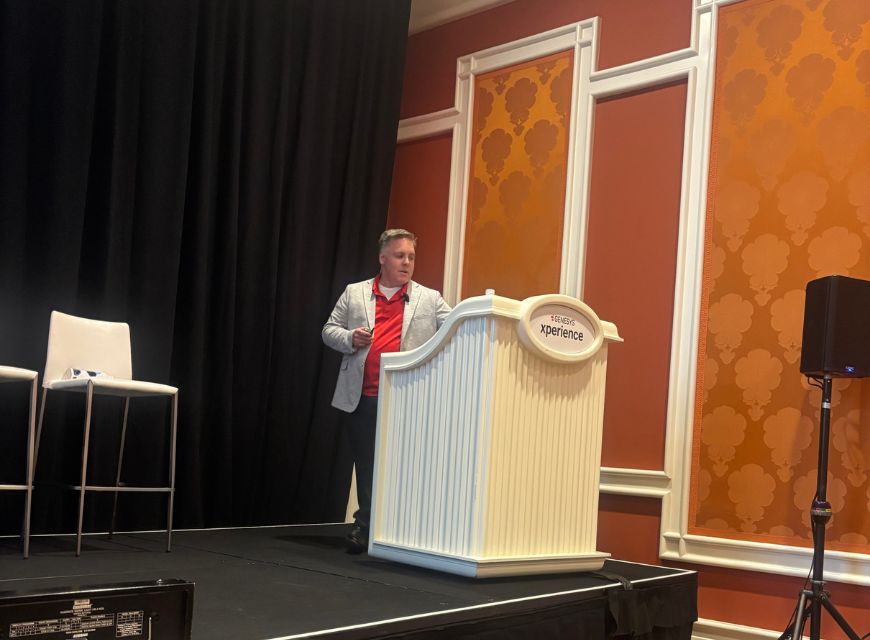
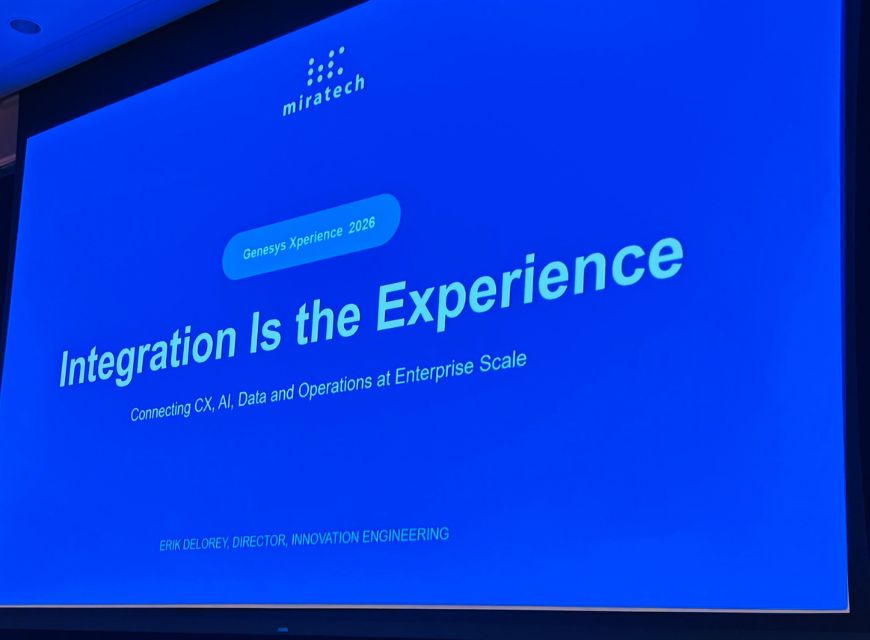
At Genesys Xperience 2026, much of the discussion focused on agentic AI and what it means for the future of customer experience. But one of the most practical sessions focused on something less glamorous and arguably more important: customer experience integration. As Erik Delorey, Director of Innovation Engineering and Product Manager for MiraCloud at Miratech, explained during his presentation:
“The challenge isn’t just what agentic AI is doing in the CX space. It’s what it’s doing in the overall enterprise space and how it’s changing the game.”
The message was simple. Most organizations do not have an AI problem. They have an integration problem. And increasingly, those two challenges are becoming inseparable.
Great Experiences Start Before the Customer Contacts You
To illustrate the point, Erik shared a real-world example involving a faulty water heater. The customer received an alert from the device, ignored it, and later received a text message prompting a call to customer support. An AI assistant guided the customer through a few troubleshooting questions, identified the likely issue, and scheduled a callback when the service center opened. The next morning, the entire conversation with the human agent lasted just over a minute. Why? Because all the work had already been done.
The warranty had been validated, the known issue had been identified, replacement inventory had been confirmed, and local technician availability had already been checked. As Erik described it: “Everything was already done. The agent was just confirming the fact that he’s going to close out this case.”
What traditionally might have been an eight- or ten-minute conversation became a 60-second interaction because every relevant system contributed context before a human became involved.
Customers Don’t Care About Systems
One of the key points from the session was that customers never see the complexity behind a great experience. Behind that one-minute service interaction were multiple systems working together:
• Device telemetry
• Event processing and business rules
• Asset management
• ERP
• CRM
• Knowledge management
• Inventory systems
• Workforce scheduling
• Genesys orchestration
The customer experienced none of this complexity, they simply got a fast answer. As Erik put it: “Eight systems had to get read from, but only one system had to be written to.”
That’s a useful reminder for CX leaders. Customers don’t care whether information lives in CRM, ERP, or a service platform. They care whether the company already knows enough about their situation to help them quickly.
The Real Barrier Isn’t AI
Research referenced during the presentation highlighted a surprising statistic: “According to the Genesys State of Customer Experience, 48% of companies don’t pass the information that the customer has already provided to the company to the agent.” Most customers have experienced this firsthand:
• Entering information into a web form.
• Repeating the same information in a chatbot.
• Then explaining the same issue again when they reach an agent.
The problem isn’t necessarily a lack of technology. The problem is that information isn’t moving efficiently between systems.
This is where many organizations find themselves today. They are trying to deploy AI on top of fragmented environments made up of multiple applications, disconnected data, and years of accumulated technical complexity.
Why AI Is Forcing Integration to Happen
Traditionally, integration projects have been lengthy and expensive, and only after those projects were complete would organizations begin exploring AI. According to Erik, that thinking is changing. “Agentic integration means that the AI program is now the fastest path to modernization and not the reward for finishing.”
This was one of the most compelling ideas from the session. Instead of waiting years to modernize every system, organizations are using AI initiatives to identify the systems that matter most and connect them first.
In one example discussed during the presentation, a company was operating more than ten ERP systems. Initially, leadership assumed a large-scale consolidation effort would be required before any AI initiative could move forward.
The reality was different. Analysis showed that only three systems were responsible for the majority of transactions and business value. The result was a much more targeted modernization strategy with measurable outcomes delivered far sooner than originally expected.
A Different Way to Think About Transformation
The traditional transformation roadmap often looks like this:
Modernize → Integrate → Innovate
The session challenged that sequence. Organizations pursuing AI are discovering that integration work becomes easier to prioritize when there’s a clear business outcome attached to it.
Instead of asking:
“How do we modernize everything?”
The better question may be:
“Which systems need to work together to support a better customer journey?”
As Erik noted: “The AI project often becomes the reason integration finally starts happening.” That’s a significant shift in mindset and one that many organizations are beginning to embrace.
The Takeaway
The most important lesson from the session wasn’t about AI models, copilots, or automation technologies. It was about context. The organizations delivering the best customer experiences are not necessarily those with the newest platforms. They are the organizations that can connect information across systems and make it available when it’s needed.
Or, as Erik summarized: “The customer never saw any of that complexity. They simply got an answer.”
In the end, that’s what customers remember: the experience.
Before investing in your next transformation initiative, assess your readiness with our Pre-Flight Integration Inventory.
👉 Download the free inventory:
Get the Pre-Flight Integration Inventory