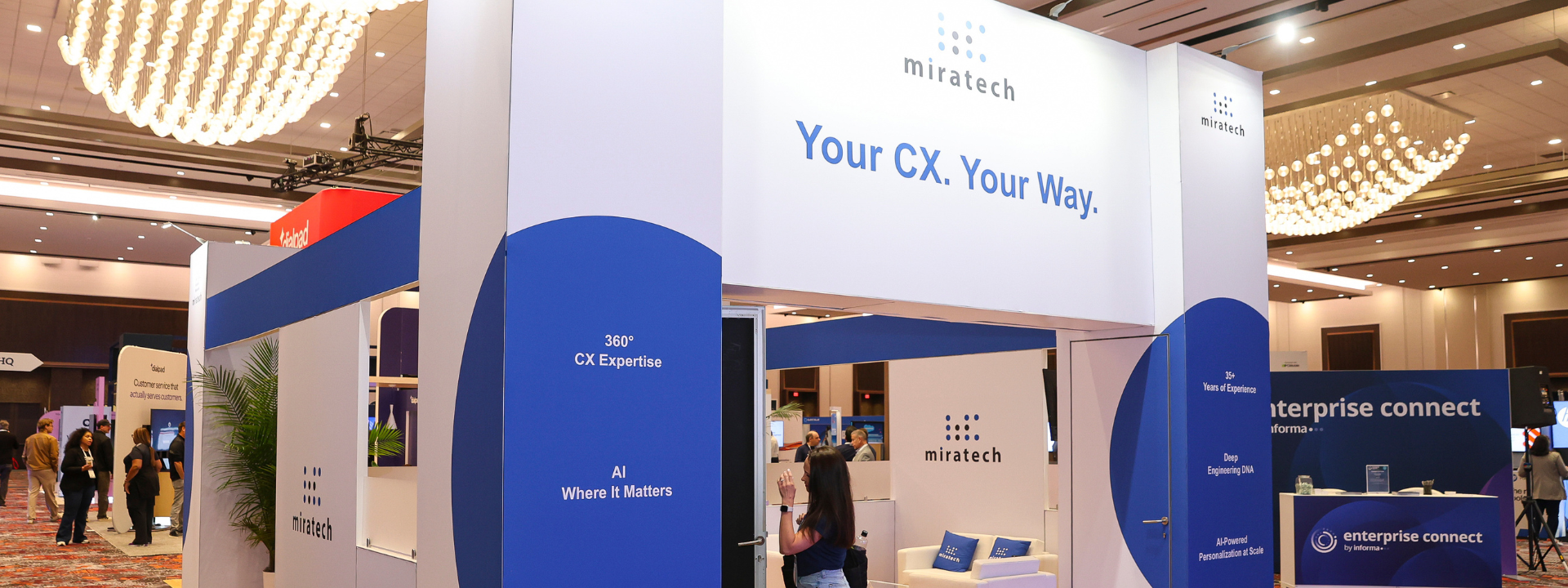
Enterprise Connect 2026 brought together enterprise leaders across CX, architecture, AI, and transformation to unpack what’s holding organizations back from turning AI and CX ambition into real value outcomes. Alongside conversations on the expo floor, panels, and insight sessions, one theme kept coming up: AI in CX is moving fast — enterprise ways of working with it are not.
Here are five of the biggest takeaways from the event, through the lens of our team who were on the ground.
1. AI Strategy Is Still Being Driven by Emotion, Not Outcomes
Alexander Maximenko, Vice President of Solution Architecture, shares his take:
“One theme that came up repeatedly at Enterprise Connect is that many organizations are deploying AI in the contact center using the same mindset they used for traditional software projects. They launch a bot, focus on containment rates, and assume the job is done. But if the bot can’t actually resolve the customer’s issue, all you’ve done is trap the customer in a faster IVR.
At the same time, automating the easy interactions often leaves agents handling only the most complex and emotionally charged problems, while the AI itself is pulling from outdated or fragmented knowledge sources. AI in the contact center isn’t a ‘deploy and forget’ technology — it requires strong data foundations, connected systems, and continuous tuning to improve the customer and agent experience.”

2. Complexity Is Quietly Diluting CX Transformation
Adam Underkoffler, Vice President of Strategic Alliances, reflects:
“One of the most consistent patterns we hear from enterprise teams is how often organizations end up buying overlapping CX and AI capabilities without realizing it. CCaaS platforms, CRM systems, cloud providers, and standalone AI tools are increasingly delivering similar functionality, and different teams often procure them independently. The result is duplicate investment, growing complexity, and fragmented customer experiences. In many ways, this reflects the broader convergence happening across the CX ecosystem, where multiple platforms are expanding into adjacent capabilities at the same time. The real challenge today is not choosing the wrong platform. It is navigating that convergence without creating unnecessary overlap.”
3. Agentic AI Is Exposing the Limits of Legacy Delivery Models
Erik Delorey, Director of Innovation Engineering, comments:
“A lot of organizations are trying to deploy LLM-driven and agentic AI using delivery models designed for traditional software. That mismatch showed up again and again in conversations at Enterprise Connect. AI systems don’t behave like static applications — they evolve, learn, and need continuous tuning. When enterprises apply rigid requirements, long procurement cycles, and “one-and-done” delivery thinking, they stand in the way of the very capabilities they’re trying to unlock.”

4. AI Adoption Is Stalling Because People Aren’t Being Taught How to Work With AI
Oksana Krutybich, Director of Sales, shares her perspective:
“Training is still being treated as a functional rollout task instead of a culture and mindset shift. Many end users are being shown which buttons to click, but not how to think differently when using AI. That creates a ‘right or wrong’ mindset that discourages experimentation and learning. At Enterprise Connect, it was clear that the organizations seeing real CX and productivity gains are the ones investing in continuous enablement and training, helping people develop judgment, confidence, and curiosity when working with AI systems.”
5. Governance Is Becoming the New Bottleneck to AI at Scale
Jagdish Misra, Vice President of Strategic Accounts, shares his insight:
“At Enterprise Connect 2026, one theme stood out clearly: enterprises are eager to deploy AI in customer experience, but many are still approaching it as a technology experiment rather than a business transformation. The organizations getting it right are not just deploying bots, they are redesigning end-to-end customer journeys, integrating AI deeply with knowledge, data, and human agents, and aligning CX outcomes directly with revenue, cost efficiency, and customer loyalty. The real opportunity for Fortune 100 leaders is to move beyond isolated AI pilots and treat AI as the operating layer of the modern contact center—where automation, human expertise, and real-time intelligence work together to create truly differentiated customer experiences.”
Final Thoughts
Enterprise Connect 2026 reinforced a hard truth: AI isn’t being held back by technology; it’s being constrained by how enterprises decide, buy, design, adopt, evolve, and govern it.
The organizations that move from AI experimentation to AI impact will be the ones willing to modernize not just their platforms and ecosystems, but the operating models around them.
If AI is on your roadmap this year, the real question is: are you ready for it? We help enterprise teams simplify platform decisions, embed responsible AI, and scale CX transformation with clarity.
Contact us today to find out more.